
Malcolm's Top 3 Recommendations for Philanthropists to Emphasize in 2026
1. Listen intently.
In a time of over abundant information, disinformation, and strong opinions it is more important than ever for philanthropists to listen intently. Listen to people working in your field of interest, listen to your grantees and potential grantees, and listen to the people they serve. Ask questions and listen some more.
2. Trust your grantees.
Choosing a grantee is the philanthropist’s most important and difficult task. Once that choice is made then you must trust unreservedly. Ask your grantee what it needs. If your grantee needs money to pay salaries, buy new equipment, or hire a new employee, honor that need. Your grantee knows its business better than you do and it is doing the work of advancing your respective missions. If you cannot trust your grantees then there is either something wrong with your choice of grantees or something wrong with your grantmaking approach.
3.Develop a culture that values risk taking.
Catalytic philanthropy requires gumption and calculated risk taking. Solutions are usually found by people who have the courage to try something new. Resist timidity and the temptation to make the same (safe) grants every year. A word of caution: do your homework. Don’t confuse recklessness with a calculated risk.
Praise for Malcolm Macleod
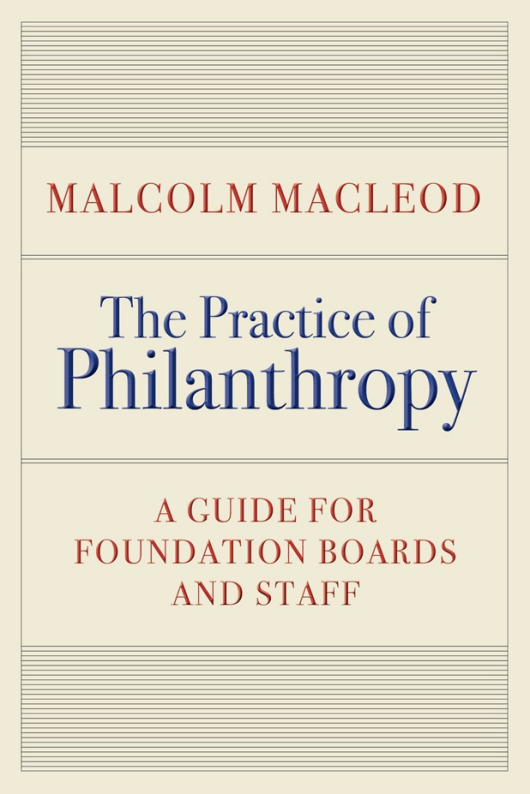
“The Practice of Philanthropy is a readable guide to grant making, investing, and the business of running a foundation. It combines practical advice from Malcolm’s many years of doing this work with his deep knowledge of the principles behind it. This book is full of advice and examples that foundation leaders will either recognize or face in the future.
It will help foundation leaders achieve impact and the satisfaction that comes with it.”
– The Right Honourable Paul Martin, Canada’s 21st Prime Minister
“When I transitioned from running a non-profit organization to leading a lean philanthropy, I wanted to learn as much as I could about my new field. A colleague and mentor recommended reading, The Practice of Philanthropy, and it started to click. Malcolm has the unique skill of taking complex ideas or philosophies and breaking them down into practical directives. Then I had the chance to work with Malcolm one-on-one, which allowed me to really appreciate his philanthropy expertise and his talent as a teacher.”
– Ethiel Garlington, The 1772 Foundation
“Malcolm Macleod’s knowledge, wisdom and experience is invaluable to the
business of successfully running a foundation…”
– Peggy Brittain,
Board Member, New Brunswick
Children’s Foundation
About the Author
MALCOLM MACLEOD is Chair of the Board of Directors of the Johnson Scholarship Foundation. The privately endowed U.S. foundation gives grants to organizations that help people overcome barriers to education and employment. He was president and CEO of the foundation until he retired in April 2020.
Born in Amherst, Nova Scotia, Macleod joined the firm of Patterson, Smith, Mathews and Grant as an associate and practiced with that firm and its successors for over 25 years. During that time, he served as managing partner and chair of the firm’s litigation department. He was appointed Queen’s Counsel in 1997.
This Essential Book:
Principles of grantmaking
Shows readers both the principles of grant-making, and how to put them into practice to make more effective grants.
Recruit and engage
Shows readers how to master the practice of philanthropy so they will be able to recruit and engage an excellent board, achieve superior investment returns, and make impactful grants.
Maximize impact
Gives readers an inside view of how foundations work and how to run them in a way that maximizes the impact of the grants.
Key Highlights
- This book comes from the voice of experience—a foundation leader who worked for 30 years at a large private foundation in the U.S. and as a board member of a small community foundation.
- Explains the theory of running a grant-making foundation, and how to put that into practice.
- Essential reading for any foundation, with or without professional staff, that wants to
make a real impact.
“Here is a book (finally!)) that speaks comprehensively and powerfully to the unique challenge of running a foundation. With practical insights and wisdom gleaned from years of experience, Malcolm Macleod explores the crucial elements required for impact, from building strong relationships with nonprofits to getting the most out of a governing board to managing an endowment. Skillfully weaving powerful stories of impact that remind us why this work matters with practical insights and tips for those who find themselves leading foundations, Macleod’s book is the most comprehensive resource for foundation leaders I have seen. Every foundation CEO, aspiring CEO, and board member needs this book.”
“The Practice of Philanthropy is a readable guide to grant making, investing, and the business of running a foundation. It combines practical advice from Malcolm’s
many years of doing this work with his deep knowledge of the principles behind it.
This book is full of advice and examples that foundation leaders will either recognize or face in the future. It will help foundation leaders achieve impact and the satisfaction that comes with it.”
“Malcolm Macleod’s knowledge, wisdom and experience is invaluable to the business of successfully running a foundation. Guiding our Board’s strategic planning session, he demonstrated an incredible knack for drawing out varied opinions and diverse outlooks from all participants and translating these into a
cohesive and workable path forward. He was practical, engaging, interesting, informed and a visionary. A good listener with excellent inter-personal skills, he has helped us create values, a vision and mission of which we can truly be proud in carving out our future.”
“Malcolm’s title the Practice of Philanthropy could not be more apt. This is an invaluable ‘how to’ guide
based on three decades of experience. He shares many of the do’s and don’ts of leading a non-profit organization. But the word ‘practice’ also invokes that taking the best lessons from business can lead to a more effective foundation. Do some of the rules that define a well-run law practice or investment
management partnership apply to small non-profits?
This book paints that picture – how to tackle the challenge of doing the greatest good with the limited funds and human capital that every foundation has at its disposal. Malcolm sees his investments in grantee ‘partners’ in terms of maximizing return on investment, leveraging investments where possible, taking calculated risks to find new solutions and on how working with the ‘customer’ collaboratively leads to a better understanding of the grantee’s true
needs.”